7 Best Glass Door Hardware Safety Standards for Buyers

Time:2026-10-03 Author:Mason
0%

Glass door hardware safety standards deserve more attention than a polished handle or impressive hinge can provide. A glass door is a complete system. The panel, patch fittings, pivots, locks, closers, and surrounding frame must work together.

The World Health Organization reports that falls cause approximately 684,000 fatal injuries worldwide each year. That figure covers many environments, not only glass doors. Still, it shows why impact protection and controlled movement matter. The U.S. Consumer Product Safety Commission’s architectural-glass safety requirements, including 16 CFR Part 1201, address hazardous breakage. ANSI Z97.1 adds performance criteria for safety glazing materials. BHMA A156.4, A156.10, and A156.19 help buyers evaluate door closers and automated operation.

The details are physical.

A poorly adjusted closer can slam a door against its stop. An unsuitable pivot can overload the glass edge. A missing safety marking can make replacement decisions uncertain. As glass safety engineer David Borland has stated, “A safe door is a system, not a single component.” That principle guides this buyer-focused review of Glass door hardware safety standards.

The National Glass Association’s glazing guidance also emphasizes compatible materials, correct installation, and documented testing. Buyers should verify evidence, not trust attractive packaging. Product claims can be incomplete. Installation conditions may differ from laboratory tests. That limitation deserves honest attention.

This guide examines seven practical standards and checks. It considers impact resistance, load capacity, closing force, corrosion protection, emergency access, and installer competence. The goal is simple: fewer surprises at the doorway.
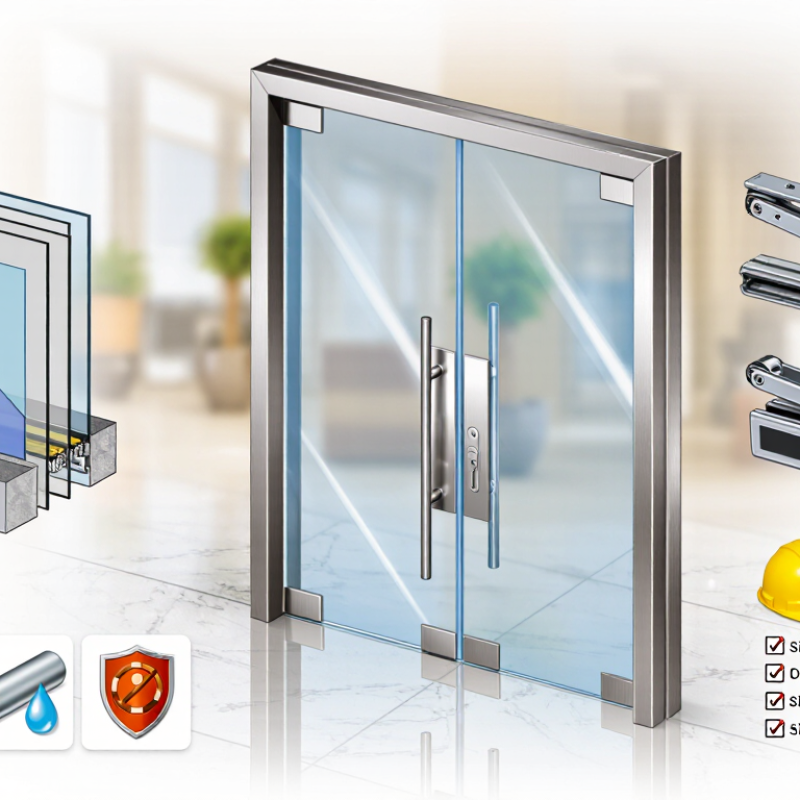
7 Best Glass Door Hardware Safety Standards for Buyers

Define Buyer Criteria: Glass Type, Door Mass, Usage, and Failure Risks

Buying glass door hardware starts with the door, not the handle. Confirm whether the panel is tempered, laminated, or annealed glass. ANSI Z97.1 and CPSC 16 CFR 1201 define impact-performance requirements for safety glazing. They do not make unsuitable hardware safe.

Measure the panel’s height, width, thickness, and total mass. A small error can overload hinges, pivots, or clamps. Select hardware with a stated load rating above the measured door mass. Include handles, seals, and accessories in the calculation.

Usage matters too. A quiet bathroom door faces different stress than a busy commercial entrance. Ask for cycle-test results, corrosion resistance, and adjustment limits. The ASTM framework for door hardware testing can help buyers compare evidence, not just catalog claims.

Failure risks deserve a written review. Check glass edges for chips, hinge fasteners for pull-out, and floor conditions for uneven loading. Confirm that the door cannot strike a wall, frame, or nearby person.

The CDC’s WISQARS injury data reports more than eight million fall-related emergency visits in the United States during 2021. That figure is not specific to glass doors, but it shows why impact zones deserve attention.

I would also question vague terms like “heavy duty.” They sound reassuring, yet provide no measurable load or cycle rating. Even a careful specification can fail when installation tolerances are ignored. Safety depends on the complete assembly, not one attractive component.

Verify Impact Safety: ANSI Z97.1 and CPSC 16 CFR 1201 Testing

When buying glass door hardware, verify the glass, not only hinges, locks, or handles. Impact-rated glazing can reduce dangerous breakage near entrances, bathrooms, and busy corridors. Ask for test documentation showing compliance with ANSI Z97.1 and CPSC 16 CFR 1201. These standards evaluate safety glazing under controlled impact conditions. They do not automatically approve every complete door assembly. That distinction is easy to miss.

ANSI Z97.1 commonly identifies glazing performance through impact classes and marking requirements. CPSC 16 CFR 1201 uses impact categories for architectural glazing within its scope. Confirm that the glass thickness, dimensions, treatment, and location match the tested configuration. A certificate for one panel may not cover a larger panel or different installation. Also check whether drilled holes, cutouts, or edge work affect the tested design. Hardware still matters. Poor alignment can create stress around fittings, even with compliant glass.

Tips: Request a dated test report, permanent glass markings, and installation instructions. Ask who performed the testing and whether the report identifies the exact product configuration. Measure the opening carefully. If records conflict, pause the purchase. That may feel inconvenient, but guessing here is a costly habit. સલ

7 Best Glass Door Hardware Safety Standards for Buyers

Verify Impact Safety: ANSI Z97.1 and CPSC 16 CFR 1201 Testing

The chart compares impact-test energy thresholds used to classify safety glazing. ANSI Z97.1 uses Class A, B, and C impact classifications, while CPSC 16 CFR 1201 uses Category I and Category II based primarily on glazing size.

Values shown are impact-test thresholds in foot-pounds (ft-lb). Always confirm the applicable standard edition, glazing size, installation conditions, and certification documentation before purchasing glass door hardware or safety glazing.

Sources: ANSI Z97.1 safety glazing classification requirements; U.S. Consumer Product Safety Commission, 16 CFR Part 1201, Safety Standard for Architectural Glazing Materials.

Assess Glass Quality: ASTM C1048 and EN 12150 Heat-Treatment Rules

For glass door buyers, heat treatment is more than a “tempered” label. ASTM C1048 covers heat-strengthened and fully tempered flat glass. It addresses thickness, dimensional tolerances, bow, and visual quality. However, ASTM C1048 does not replace impact-safety requirements. Buyers should also verify the applicable safety-glazing test and certification.

EN 12150-1 provides more specific performance details for thermally toughened soda-lime glass. Its thermal durability test uses a temperature difference of 200 K. The standard also defines fragmentation requirements by glass thickness and pane area. A compliant pane should break into many relatively small particles, not large sharp shards. Ask for the test report, production date, glass thickness, and permanent marking. Check that drilled holes, cut-outs, and polished edges were completed before heat treatment.

The hardware still matters. Hinges, clamps, and locks must match the glass thickness and drilled-hole layout. Poor alignment can create concentrated stress near an edge. I have seen “certified” glass fail in practice because the mounting details were ignored. That is an uncomfortable point. A certificate alone is not enough. Buyers should compare the report with the actual pane, inspect edge quality under bright light, and confirm installation tolerances with a qualified glazier. ASTM C1048 and EN 12150-1 are strong references, but neither can correct careless handling or unsuitable door hardware.

Check Hardware Access: BHMA A156.1, ADA’s 5-lb Force, and 32-in Clear Width

Glass door hardware should be checked for access, not appearance alone. ANSI/BHMA A156.1 evaluates butt hinges through load, cycle, and durability testing. Buyers should match the hinge grade with door weight, traffic, and glass configuration. A heavy door with underspecified hinges may sag, scrape flooring, or reduce the opening width.

Measure the clear opening with the door positioned at 90 degrees. The 2010 ADA Standards, Section 404.2.3, require at least 32 inches of clear width for most accessible doors. Handles, pivots, and stops can quietly reduce that space. Measure the finished opening, not the frame label. Small errors matter.

Opening force matters too. Section 404.2.9 limits interior, non-fire door opening force to 5 pounds. Use a calibrated force gauge at the handle, rather than relying on hand pressure. Excessive closer tension, tight seals, or misaligned hinges can push the reading above the limit. Exterior doors are treated differently under the ADA standard, so local requirements still need review.

A good inspection records hinge type, clear width, and measured force. Keep photographs and test readings. That evidence helps resolve installation disputes. Standards are precise, but field conditions are not. One overlooked floor transition can create a real access problem. Industry guidance is useful; careful measurement is better.

Confirm Installation Compliance: ICC A117.1, Labels, Records, and Warranties

Before buying glass door hardware, confirm how the complete assembly meets ICC A117.1 accessibility requirements. This standard addresses usable clearances, operating forces, and accessible reach ranges. It does not replace local building, safety, or fire requirements. Ask for the exact compliance statement, not a vague claim that the hardware is “approved.”

Inspect every label before installation. Product markings should identify load ratings, material information, and relevant testing details. Labels must remain visible after fitting. Keep them readable. Photograph each label beside the installed component. A clean appearance can hide a missing rating or incorrect fastener.

Create a simple compliance file with invoices, product sheets, installation instructions, inspection notes, and dated photographs. Record who installed the hardware and when adjustments were made. Confirm that the warranty covers the actual use, door weight, environment, and installation method. Many buyers overlook exclusions involving corrosion, misuse, or unauthorized modifications. That is worth checking twice. A warranty also cannot correct a poor installation. If the door drags, closes too quickly, or needs excessive force, stop and investigate. The paperwork may look complete, yet the assembly can still fail in daily use. Recheck measurements after installation, because site conditions sometimes differ from drawings. That small second review may expose a clearance problem before it affects accessibility or user safety.

7 Best Glass Door Hardware Safety Standards for Buyers — Confirm Installation Compliance: ICC A117.1, Labels, Records, and Warranties
No. Buyer Safety Check Applicable Standard or Requirement What Compliance Should Confirm Evidence to Request Installation Risk Controlled
1 Accessibility and Reach Range
Check the door, pull handle, latch, and operating force.
ICC A117.1
Accessible and Usable Buildings and Facilities. The applicable edition is the one referenced by the adopted building code.
Hardware should be usable without tight grasping, pinching, or twisting. Clear floor space, maneuvering clearance, opening force, and mounting height must be checked against the adopted code and project type. Hardware schedule, accessible-detail drawings, field measurements, and the authority having jurisdiction’s approval where required. Reduces inaccessible operation, excessive force, blocked approach space, and hardware mounted outside the permitted reach range.
2 Safety Glazing Classification
Confirm that glass in hazardous locations is safety glazing.
16 CFR Part 1201 and ANSI Z97.1
Federal safety-glazing requirements and performance criteria for architectural glazing, as applicable to the installation.
Glazing used in doors and other hazardous locations should be certified for the required impact category and thickness. The exact requirement depends on location, size, glass type, and the adopted building code. Test report or certification showing the applicable impact classification, glass construction, thickness, and production traceability. Helps reduce the risk of ordinary annealed glass being installed where impact-resistant safety glazing is required.
3 Permanent Safety Marking
Inspect the glass label before installation and after cleaning.
Applicable building-code safety-glazing marking provisions, supported by ANSI Z97.1 or 16 CFR Part 1201 certification. The mark should be permanent and legible, and should identify the applicable certification or test basis. A removable paper sticker alone is not a reliable permanent compliance record. Photograph of the permanent mark, certification information, glass type, thickness, and location of each labeled panel. Prevents loss of traceability and makes it easier to distinguish certified safety glazing from non-certified replacement glass.
4 Tempered or Heat-Treated Glass Verification
Confirm the specified glass treatment and fabrication limits.
ASTM C1048
Standard specification for heat-treated flat glass, including fully tempered and heat-strengthened glass categories.
The delivered glass should match the specified treatment, thickness, size, edge condition, and visual-quality requirements. Heat-strengthened glass is not automatically interchangeable with fully tempered safety glazing. Product data, purchase order, inspection report, and permanent marking or documentation identifying the heat-treatment category. Reduces breakage, mismatch, and substitution risks caused by using the wrong glass treatment for the door assembly.
5 Hardware and Glass Compatibility
Verify holes, notches, clearances, gaskets, and load limits before drilling or fitting.
Project-specific manufacturer installation instructions, approved shop drawings, and the adopted building code. Where applicable, use recognized hardware and door-assembly test requirements specified by the project documents. Hardware must be rated for the glass thickness, door size, weight, swing or sliding action, and intended use. Glass edges, holes, and notches must be fabricated as specified; field modification should not occur without written approval. Signed shop drawings, hardware schedule, glass fabrication drawings, fastener specifications, and installer checklist. Controls edge damage, stress concentration, loose fittings, overloaded hinges, and hardware separation during operation.
6 Installation and Inspection Records
Create a traceable record from delivery through final acceptance.
Project specifications, inspection requirements, and the adopted building and accessibility codes. Record retention should follow the contract, permit, and applicable legal requirements. The installation should be inspected for plumb and level alignment, secure fasteners, correct gaskets, safe clearances, smooth operation, accessible hardware, visible labels, and absence of damage. Delivery inspection, photographs, glass-label log, torque or fastening records where specified, punch-list closeout, and signed final inspection report. Provides evidence of compliance and helps identify damage or installation defects before the door is placed into regular service.
7 Warranty and Maintenance Controls
Confirm what is covered and how the assembly must be maintained.
Written project warranty, applicable code obligations, and the hardware and glazing maintenance instructions supplied for the installed assembly. The warranty should state coverage period, exclusions, service response, replacement procedure, finish limitations, and whether unauthorized drilling, adjustment, cleaners, or modifications void coverage. Dated warranty certificate, serial or installation reference, maintenance schedule, cleaning instructions, spare-part information, and handover documents. Reduces premature failure caused by loose hardware, corrosion, unsuitable cleaners, neglected adjustments, or unapproved alterations.
Buyer note: Code requirements vary by jurisdiction, occupancy, door type, and installation location. Confirm the adopted code edition and final acceptance requirements with the project design professional, building official, or authority having jurisdiction before purchase and installation.

FAQS

What should I check before buying glass door hardware?

Start with the glass door panel, not the handle. Confirm whether it is tempered, laminated, or annealed glass.

Which measurements are necessary for hardware selection?

Measure the panel’s height, width, thickness, and total mass. Include handles, seals, and other attached accessories.

How much load capacity should the hardware provide?

Choose hinges, pivots, or clamps with a stated load rating above the complete door mass. More capacity is safer.

Does door usage affect hardware requirements?

Yes. A quiet bathroom door experiences less stress than a busy commercial entrance. Consider daily traffic and closing force.

What testing evidence should buyers request?

Ask for cycle-test results, corrosion resistance, load ratings, and adjustment limits. Vague terms like “heavy duty” are not enough.

How can impact safety be verified?

Request dated test reports and permanent glass markings for applicable safety-glazing standards. Check the exact glass thickness and configuration.

Does a safety-glazing certificate approve the complete door assembly?

No. Testing may cover one glass configuration only. Hardware alignment, drilled holes, cutouts, and installation conditions still matter.

What installation risks should be reviewed?

Inspect glass edges for chips and hinge fasteners for pull-out. Check uneven floors and confirm the door cannot strike walls or people.

Why should the surrounding impact zone be considered?

A door may hit a frame, wall, or nearby person during movement. Leave clear space around the swing path.

What should I do if measurements or documents conflict?

Pause the purchase and recheck everything. Guessing feels quicker, but small errors can overload the assembly.

Conclusion

Choosing safe glass door hardware begins with matching the system to the glass type, door weight, traffic level, and possible failure risks. Buyers should confirm that the glass has been tested for impact resistance under ANSI Z97.1 and CPSC 16 CFR 1201 requirements, helping reduce injury risks from accidental breakage. Glass quality should also be reviewed through heat-treatment criteria such as ASTM C1048 and EN 12150, with attention to proper processing, consistency, and suitability for the intended application.

Glass door hardware safety standards also cover accessibility and installation. Hardware should provide practical access, operate with no more than 5 pounds of force where applicable, and support a clear opening of at least 32 inches. Installation should follow relevant accessibility guidance, including ICC A117.1, while product labels, inspection records, maintenance instructions, and warranty terms should be retained. A complete review of these factors helps buyers select a reliable door assembly and establish clear evidence of safety, quality, and proper installation.

Mason

Mason

Mason is a seasoned marketing professional with a deep expertise in the company's offerings and a passion for driving brand awareness. With a strong background in digital marketing strategies, he has an innate ability to connect with diverse audiences and effectively communicate product benefits.......